A spreadsheet per block
One file per block, per season. Adding them up across blocks for the year is a project of its own.
For logging contractors, tree services, silviculture and planting crews, and hauling. We build one system in Airtable that ties every load, crew day and machine hour to the block it came from, so the invoice matches the work.
For owner-led businesses of 5 to 50 people in Canada and the US.
Load slips, scale tickets, timesheets and fuel receipts come back in a truck. Someone types them into spreadsheets at night, matches them up and hopes nothing went missing before the statement arrives.
Did load 41 make it onto the statement? Whose hours are missing for Block 7? When is the skidder due for service?
One file per block, per season. Adding them up across blocks for the year is a project of its own.
They get wet, they get lost and they get entered late. A missing ticket is money you don't get paid.
Knows what you invoiced. Has no idea which loads, crew days and machine hours that invoice should have included.
Each block or contract has its crews, equipment, loads and costs linked to it. Crew leads send in the day's hours and loads at the end of the shift, on a phone or on the paper form they already use. Scale tickets are matched to loads, and any load without a ticket is flagged.
As tickets and hours come in, each block's totals update themselves: volume, revenue, crew cost and machine hours. You see which blocks are making money while you're still working them.
Good people are hard to find, and nobody wants to lose one over software. So we work out with you the simplest way for each person to get their part in, and set the system up around that.
Every cab, crummy and the camp fuel tank gets a laminated card with a QR code. The machine or the place is already filled in, and a daily check is one tick and a few numbers. Nothing to install and no login.
Anyone who'd rather use the paper form can. It still lands in the right place in the system, without anyone in the office typing it in again.
A problem becomes a work order for the mechanic. A close call goes to the safety coordinator. The owner sees all of it on one screen.
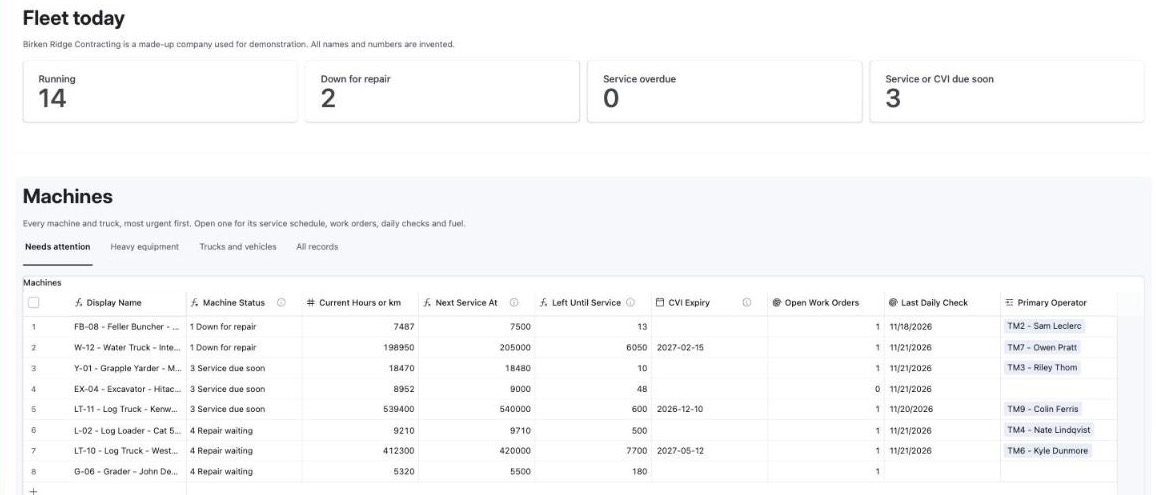
The operator scans the code in the cab and the machine is already filled in. One tick for the walk-around, the hour meter, and whether anything is wrong. The checklist lives on the laminated card, not in a long list of boxes on a phone.
Anything wrong goes to the mechanic as a work order straight away. A machine marked unsafe is tagged out until the mechanic signs it off.
Replaces: the clipboard in the cab that nobody reads.
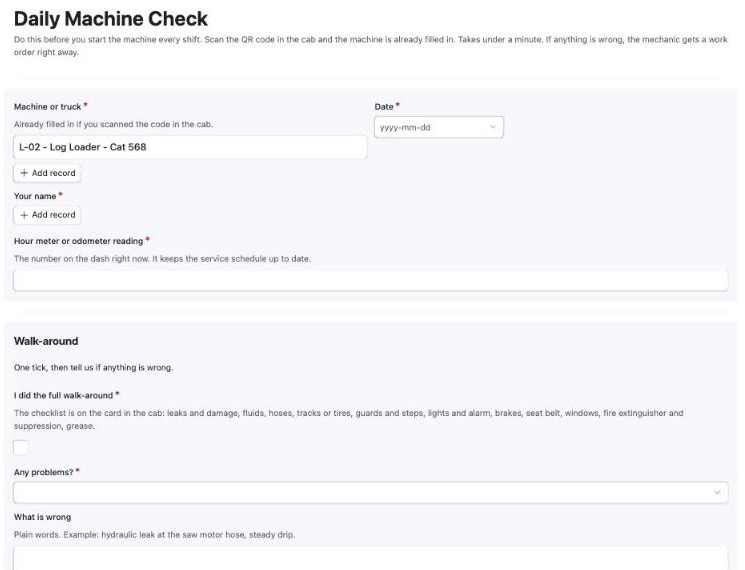
Hour meters come in from the daily checks and the fill-ups, so service comes due on its own. Machines that are down, overdue for service or waiting on a repair rise to the top of the list.
Open a machine and you see its service history, open work orders, daily checks and fuel in one place. The maintenance records your SAFE audit asks for are already there.
Replaces: the whiteboard in the shop and the service sticker on the dash.
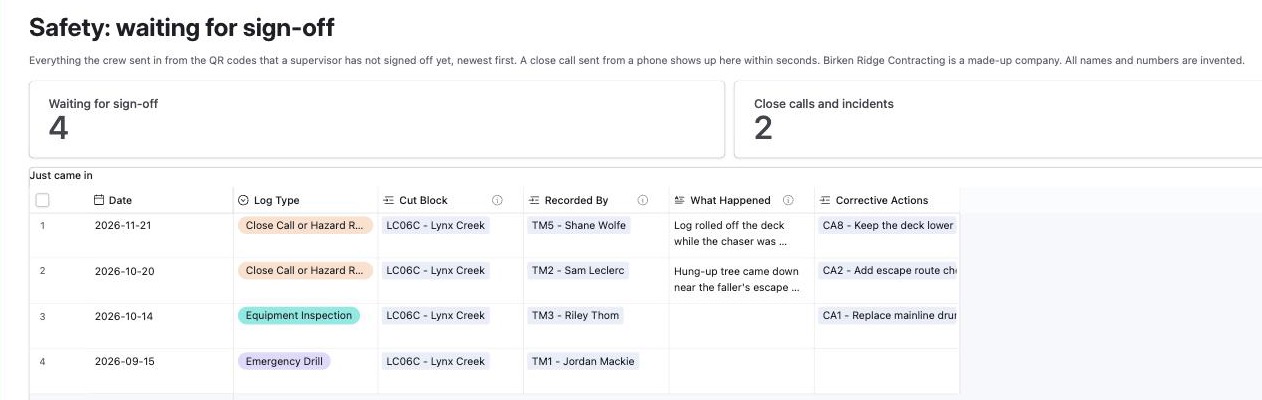
Safety reports waiting for sign-off, fixes that are overdue, machines that are down, today's dispatch, crew hours for the week, tickets about to expire and fuel that needs a look. Most urgent first.
A close call sent from a phone at the landing shows up here within seconds, with a corrective action already drafted.
Replaces: the morning round of phone calls to find out what happened yesterday.
One system, so the bush, the shop and the office work from the same numbers.
Blocks and contracts with their crews, dates and progress.
Read moreEquipment service, safety checks and tickets that expire.
Read moreFuel, parts and supplies, tracked against the block they were for.
Read moreInvoices built from loads, hectares or days already logged.
Read moreVolume, revenue and cost by block, always current.
Read moreSafety and crew meetings with actions that get done.
Read moreWe're a small team in the Sea to Sky, surrounded by logging, hauling and tree service businesses. We know the work runs on seasons, weather and crews, and we build systems that fit around it.
We built a complete system for BC logging companies: crew hours, dispatch, SAFE audit evidence, equipment, fuel and contractors. The screens on this page come from it, filled with a made-up company so we can show how it works without showing anyone's real numbers.
Working out machine cost by hand meant exporting the job cost report, pasting it into a spreadsheet and keying in Blue Book rates and fuel for every unit. One wrong cell and the answer is off. We built Lizzie Bay Logging a database that matches each unit to its rate and its fuel and does the math itself. Management sees sort yard cost per cubic metre, year by year, without waiting for someone to pull it together. Their numbers stay theirs, so you won't see them here.
For VanUrban Timber in Squamish, we built a system that went through their boom data log by log to find the prime logs that could be cut into larger posts. On custom-cut day at the mill in Langley, their scaler was on site with that list and flagged each log that needed to be cut a certain way, so the boom earned as much as it could.
In the Blueprint we lay out every ticket, timesheet and statement your business handles, who fills it in and where it goes. Then we decide what the system should do with each one, and you see the price before we build.
The system fits best when the paperwork has grown faster than the office.
"Alison and I worked together on fuel supply and delivery contracts and various other initiatives over nearly five years. She was always prompt, professional and detail oriented."
Kerry Mehaffey, Executive in Indigenous government and business
Most contractors start with the core system and add equipment and crew tracking.
We map your blocks, crews, tickets and billing, and where the paperwork goes missing today.
We build your system, bring in your open blocks and equipment, and train the office and the crew leads. Your part is about 2 to 5 hours a week.
We keep it running and make changes as your business grows.
Prices are before tax. Canadian clients pay GST/HST on top. Payment is by credit card.
The forms need a signal to send. With Starlink at the landing, records go in on the spot. Without it, the crew sends them after the shift once they're back in range, or when they come out of camp. We set a firm cut-off, at the latest every two weeks before payroll, so nothing gets lost.
Yes. Operators scan a QR code in the cab for a daily check that takes under a minute, and the hour meter they enter counts toward the next service. A problem goes straight to the mechanic as a work order, and a machine marked unsafe is tagged out until it's fixed.
Yes. Nobody needs an app or a login. Anyone who likes their phone scans a code and fills in a short form. If someone would rather stay on paper, they keep their paper forms, and the details still get into the system without anyone retyping them. We work out with you which way suits each person, because a system only helps if your crew uses it.
Yes. Each person's tickets and expiry dates are on their record, and you get a reminder before one runs out.
Yes. Your bookkeeper keeps using QuickBooks or Xero, and the system can connect to either so invoices and payments go across without retyping. The connection is $500 CAD.
Usually 4 to 8 weeks from the end of the Blueprint to go-live, including moving your data in and testing with real work. Your part is about 2 to 5 hours a week.
Every build starts with the core system: licensees and clients, contracts, blocks, invoices, tailgate meetings and an owner dashboard, plus training and how-to guides. These are the add-ons logging and forestry contractors ask us for most. Each one is quoted separately in your Blueprint, so you only pay for what you'll use.
Tell us how the paperwork moves from the bush to the bank today. In 30 minutes you'll know what it would take to connect it.
Book a free 30-minute call